Monday, July 11, 2011

summer lovin'

Summer is in full swing and the according to the forecast, the temperature is expected to hit 100 degrees tomorrow in all the D.C. area. Let’s take a moment to all be very thankful for air conditioning, and the fact that today is free slurpee day at 7-11.

I, like most people, really love fireworks, and got a chance to see 3 displays of fireworks over the past week. And, in my opinion, it wouldn’t be a proper 4th of July unless I did some sparklers…. even though the lady who sold them to me said, ‘oh, you are getting something for the kids, that’s nice.’ No lady, they were for me!

But in all seriousness, I hope to never lose that childlike part of myself that still enjoys playing with sparklers and building sand castles at the beach. I think that a large reason I love the summer is because of my childhood memories associated with the season, as well as all the opportunity it brings for activity and recreation. In addition to reminiscing about my youth, I still feel the freedom and excitement in the air with kids being out of school and everyone having more time to play and explore and relax during the summer months. And that is something that gives this time of the year a particular spark... even through all the sweat and sunburns.

I hope everyone enjoyed the holiday and still has a lot of wonderful plans for the summer to keep cool and have fun.


Monday, July 4, 2011

independence day.

happy 4th of july!
hope everyone is having a happy holiday weekend.


Tuesday, June 28, 2011

what kind of stranger?

After having some interesting interactions with people lately, I’ve been thinking a lot about how I exist as a stranger in the world, as well as how I interact with and react to the behavior of other strangers. Perhaps it was because of my age, my life experiences, or belief system, but I used to always assume that the anonymous people I interacted with had good intentions. It’s safe to say that my world-view has been challenged, as I have been more focused on how people treat one another, and have personally received a lot of negativity and aggression from people I don’t even know. As I get older my expectations for strangers to act hostile and disrespectful have greatly increased, and at the same time, my tolerance of people acting rude has taken a sharp turn south. As much as I am trying to maintain my stance as a positive force, and a solid citizen, I find myself becoming a less likeable stranger in the midst of my confusion.

In our society we all want to assume that the strangers around us will abide by certain laws, as well as social norms of behavior. We take for granted that the millions of people around us have free will and are making a conscious choice every second whether or not they want to adhere to particular rules and regulations. In our every day interactions, we place trust in the hands of people we have never met before, and who will, in most cases, continue to remain anonymous. But keeping true to human nature, and maybe more importantly, American impatience and sense of entitlement, just as quickly as we will depend on someone else, we will turn on them.

Particularly when driving, it astonishes me to think about much we depend on each other for our own safety, and the safety of our property. Whether we are honking a horn, making a rude comment, throwing up the finger, or scowling (all things I am tempted to do daily on my commute to work), we react strongly when someone does not follow the rules, and maybe more importantly, our personal expectations. When we are enclosed in the bubble of our cars it seems like we focus even more on ourselves, and less on other people, making it much less likely to be thinking about the consequences of our behavior.

On the other hand, when we are face to face with strangers on the street, I’d like to think, in general, that people are still courteous, and respectful of one another. It is far less likely to see pedestrians nearly knocking each other over on the sidewalk, or stepping directly in front of one another without any warning, than to see an accident or swerve on the highway. But perhaps this is only because we have no barrier to hide behind or fast escape route that is provided in the safety of our cars. It seems that individuals’ tendency to offer help is based largely on physical distance as well as the ease of providing any aid. When an act takes place within someone’s comfort zone, the societal norms which regulate manners, and the enforcement of respecting the rights of others are much more likely to be applied. It is because of this that I think most people in today’s society will still see the need and importance of something as simple as holding the door open for the person behind them.

That being said, there is definitely a time and a place to be cordial, as well as unpleasant to strangers, and our process of reacting to situations happens very quickly and efficiently. Based on our own life experiences and the little information we can gather from the moment at hand, we bring assumptions to our interactions with strangers. We use personal life experience to figure out how we should deal with particular situations and people, as well as form our understanding of how others should treat us.

Unfortunately for me, my recent experiences have been leaning toward the more unpleasant end of interactions with strangers, but I will say that it has made every time someone holds the elevator for me or waves after merging in front of me, stand out much more. So, here’s to hoping that despite the rude and inconsiderate interactions we all have out there every day, that we still try our best to be kind strangers.


[check back later for more photos.]

Sunday, June 19, 2011

excused absence.

hey guys,
i've been incredibly sick this week, and i'll spare you the details beyond letting you all know that it was to the point that I was in and out of urgent care and on iv's several times. so obviously there was no additional blog posted, but I'll try my best to make it up this week.

to contrast the majority of urban scenes i've shared so far, here are some pictures of nature i've taken over the last few weeks:


Monday, June 6, 2011

fewer words.

I've been shooting a lot, but I can't get my head screwed on straight enough right now to express myself in words.
I've been taking in a lot of amazing art, and I think I just need some more time for reflection before I even attempt to explain anything.

The Canaletto exhibit at the National Gallery of Art blew me away, and I am so excited that I saw Venice captured in it's true essence of mystery, romance, contrast, and light unlike anywhere else in the world.

I also had the privilege of going to the Barnes Collection, in Lower Merion, a suburb of Philly, which was unlike any experience I have ever had, and probably will ever have with art. Seeing the way Albert Barnes grouped and displayed his masterpieces was so fascinating, and truly is a work of creation and artistic expression itself.
The collection is composed of countless masterpieces by Renoir, Cezanne, Matisse, Seurat, and Picasso, to name a few. I was most impressed with seeing Van Gogh's 'Postman' Seurat's 'Models,' and Monet's 'Le Bateau-atelier' in person.
I encourage everyone to go see it the way it was intended to be viewed, before the city of Philadelphia moves it downtown at the end of this year. (There is also a movie on the collection as well as the controversy that I highly recommend, called, 'The Art of the Steal').

I'll have another post up this week with more substance, but for now I'll share these pictures primarily from my trip to Philly and the surrounding areas.


Thursday, May 26, 2011

where art is.

I took a trip to the Baltimore Museum of Art (BMA) about a week ago to see a photography exhibit, and it turned out to be a much more fulfilling and thought provoking trip than I had planned for. First off, I had never been to this museum before, and was very pleasantly surprised at how fantastic the whole collection was, and I really liked the overall layout and organization of the museum. The sculpture garden is also quite beautiful, and the landscaping plays along and adds to the works in a way that I have not often seen. The carefully maintained trees, bushes, and flowers seemed to compliment each work perfectly, while providing a sense of calm and peacefulness.

The BMA is full of a lot of Matisse, Monet, Picasso, etc., but the main reason I went there, was to see the exhibit, “Seeing Now: Photography Since 1960.” The show included works from Diane Arbus, Cindy Sherman, and Lewis Baltz, among others. One of my favorite pieces in the show was, “Black Supper” by photographer Andres Serrano. He is often a controversial artist who deals with much of his childhood and comments on his catholic upbringing in much of his work. This series in particular is incredibly creative and thought provoking—if you haven’t seen it, I urge you to look it up. The process is just as interesting as the image itself.

The other artwork that really caught my attention was called, “Misunderstandings (At Theory of Photography)” by Mel Bochner. This was essentially a series of quotations by various people about what photography is and what its role is in the art world, as well as society in general. I found myself reflecting on both Serrano and Bochner’s work throughout the rest of the exhibit, and felt that the show was grouped in such a way that allowed for the artists to make strong statements individually, as well as be a part of a group statement by the entire show. The photographers all fell under the theme of “Seeing Now,” yet, each photographer portrayed the present quite differently, which provided a connection between all the work, as well as a platform for dialogue and creativity.


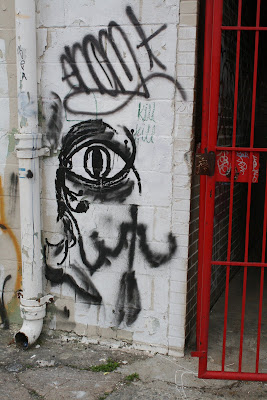
This visit to the museum was later juxtaposed with a spontaneous exploration of some street art and graffiti in the city. I stumbled upon some cool and interesting things, and then somehow discovered something called ‘graffiti warehouse’ where I shot a lot of photographs. The location is basically composed of two perpendicular alleys that connect next to an abandoned warehouse, and the whole area is being transformed into a place where graffiti can legally be created and displayed. A photographer who is associated with the project gave us an impromtu tour of the interior of the warehouse, and we were able to check out the really amazing studio spaces with all types of works in progress. The backdrop of exposed piping, old wooden floors, and an antique piano contrasted with stencils, tags and bright photographs was visually stunning. The whole concept of this project, which allows for photographers and graffiti artists to collaborate as well as rent studio space inside the warehouse, is amazing to me, and I found myself really wishing it was in DC so I could be an active part of this community.

Having viewed works in a museum just before encountering such a large display of public art, my mind was filled with ideas on everything I had just seen, and how I was reacting to it all. As many of you know, I am a huge fan of street art, and making art public and attainable to everyone who wants to see it or create it, and even for those who don’t even realize yet they want to be around art at all. People who may find museums and foreign and distant from their lives and the art inside of the buildings unable to represent or talk to the experiences they live out, may find public art much more relatable and they are more likely to come in contact with it. Simply by using the integration of the city itself, the asphalt, the concrete, the bricks, of the shared location between the artist and the audience, public art can bridge gaps that the museum cannot.

On the other side of the spectrum, museums are vitally important in the preservation of history and culture, as well as a necessary part of education in showing how humans over time have used art to express themselves. Museums and galleries have come a long way since the days where ancient artifacts, and the most prized and beautiful works of art were only reserved for the homes of the people who could afford to own them, or display them in a cabinet of wonders. These buildings provide people with the ability to see, over time, how and why artists chose to paint, draw, etc. in specific styles, as well as why they chose particular subject matters. Additionally, museums and galleries are full of information on what was happening historically at the time the artworks were created, in addition to what other artists before and after were doing. All of these particulars in the way in which artwork is displayed and the information that is kept with them allows audiences to gain a greater appreciation for the artists’ statements, as well as view first hand the advances in technique and creativity over time.

The BMA is a beautiful building that holds incredible works by world renowned artists, and displays them delicately in a controlled, neutral environment. Graffiti in the city does the polar opposite, using the city as the framework for displaying an artist’s work, taking into account the city noise, the weather, and all environmental factors. The museum provides the security of the art to not be defaced or made to say something that was not originally intended, under the protection of security guards and a building to house it, whereas street art can be painted over in moments, vandalized, or overlooked by many, blending in and becoming part of the city’s facade. On the other hand, museums require people to have enough interest take time out of their day and to walk inside a building for the purpose of viewing artwork; whereas public art, such as ‘graffiti alley’, can be seen by anyone who passes by the street. In this case, both art locations were free, both inside the same city, and both held inspiring and thought provoking art, yet they seemingly spoke about what art is, and who art is for, completely differently.

I enjoyed and was affected by both encounters with art, which shows the importance of both, while at the same time, recognizing their differences.

Art is not limited to displays in a sparse, quiet building, nor can it be fully encompassed through bright paint on a busy street.

Art can and does effect people anywhere, so long as the onlookers allow for themselves to be affected by it.




Sunday, May 15, 2011

fresh to death.

hope you guys like the new look of the blog-- i updated the template to look cleaner, and more organized.
thanks again for all of your support.